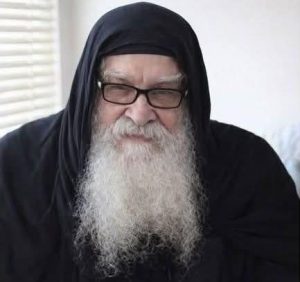
On the fiftieth anniversary of the repose of His Grace Anba Andraos of blessed memory, Bishop of Damietta, Kafr el-Sheikh and the Monastery of the Martyr St Damiana in al-Barari, we wish to remember this man of God.
Born on 10 April 1930, became a monk on 10 March 1955, consecrated bishop on 21 December 1969, departed on 4 August 1972.
At noon on Friday, 4 August 1972 (28 Epip 1688 AM), a devout soul that loved Christ departed from our earthly world to rest in the bosom of her beloved Bridegroom, whom, while still in the body, she had long sighed and yearned to see face to face and to fill her eyes with the sight of Him.
At noon the following day, Saturday 5 August 1972 (29 Epip 1688 AM), the very day of the feast of the translation of the relics of St Andrew the Apostle, the voice of His Holiness Pope Shenouda III rang out as he prayed over the soul of His Grace Anba Andraos, Bishop of Damietta, Kafr el-Sheikh and the Monastery of St Damiana. Choking with tears, he said to that good and pure soul: “Go in peace…” His Holiness could not finish the phrase; he was unable to control his emotion as he spoke it and burst into tears, and the thousands present with him in the Church of the Martyr St Damiana in al-Barari, Belqas, wept and lamented with him, grieved and moved by the departure of their gentle bishop who loved Christ, snatched suddenly from their midst while in full health, after sudden symptoms that lasted only a few hours, after which his pure soul went forth to its place of rest and its sure abode.
1 – His youth
Nabih Lotfy was born in Simaan Street, Gezirat Badran (Shubra), on 10 April 1930, the third of his brothers.
He progressed successfully and with distinction in his studies, and in his spiritual life in prayer, fasting and reading Holy Scripture, so that he spent his childhood and boyhood in peace.
In 1948 the new church of St George in Damanhour was consecrated. On the day of the consecration His Grace Anba Thomas (who departed in 1956) ordained Nabih Lotfy a deacon of the rank of reader (anagnostis). At that time the Sunday Schools had begun to feel their duty towards the villages and hamlets scattered around the towns or far from them, and university youth took it upon themselves to visit the villages and bring them the word of salvation. During the summer holidays from school Nabih Lotfy would travel to the villages and preach the Gospel to their people, then return home at the end of the day, rejoicing and exulting in the work God had accomplished that day.
When he obtained his secondary-school certificate, the blessed desire to consecrate himself to God’s service began to stir in his gentle heart, and he told his father that he wished to enter the Clerical College in Cairo. But his father wanted him to join his two elder brothers, who were studying at university, and to enter the Faculty of Engineering to become an engineer, and after much insistence he agreed. He did indeed enter the Faculty of Engineering in Alexandria in 1946, completed his studies there and graduated in July 1952. At that time the hegumen Fr Matta el Meskin was the patriarchal deputy in Alexandria and had opened an evening clerical college; he enrolled in it as soon as it opened and obtained its diploma with distinction.
During his years of study in Alexandria, from 1946 to 1955, he was constantly in touch with the societies, Sunday Schools and churches, serving his God whom he loved with all his heart, and longing more each day to consecrate his life to Him completely for all his days.
2 – His service in Alexandria
His service in Alexandria was marked by its orientation towards his peers among university youth and towards areas deprived of service. Thus in 1948 Nabih Lotfy helped to start the first university youth meeting held in Alexandria, at the Church of the Virgin Mary in Muharram Bey.
Once the meeting in that church was well established, he turned his attention to the most important area for service in Alexandria – still struggling to this day – namely Ghayt el-Enab, where Christians were crowded together, most of them poor and working-class, where groups foreign to the Church abounded as nowhere else, and where there were many societies and, with them, so many problems that service seemed almost impossible. But with his calm, his silence, his patience and his love he conquered this closed field and served it in a holy way. He became the head of the Sunday School service in that district, carrying the burden of the service and sharing the pains, problems, needs and poverty of those he served.
3 – The desire for consecration
After graduating from the Faculty of Engineering he took up work in his city, Alexandria, and carried out his duties there with skill and success. The fountain that still stands in Raml Station square in Alexandria bears witness to his competence: for its design and construction he received a special award of 300 pounds.
At that time the patriarchal deputy in Alexandria, the hegumen Fr Matta el Meskin, was about to ordain three priests for the churches of Alexandria. From Alexandria Nabih Lotfy wrote to his father in Damanhour of his wish to enter the Lord’s service and of his longing to be one of those three; but his father once again advised him to stay in his job until his brother had graduated from the Faculty of Medicine, and then to choose the path he wished.
In the early 1950s a sweeping spiritual revival had begun to blaze among educated Coptic youth. The book The Orthodox Prayer Life, published in 1952, set hearts on fire for a life of worship and contemplation following the path of the holy Desert Fathers. Young men began to come one after another to the Monastery of the Syrians seeking monastic life, solitude and contemplation, and Nabih Lotfy was one of them. On 10 March 1955 he left the world and went to the Monastery of the Syrians. His father travelled after him to persuade him to postpone entering monastic life until his brother had finished his medical studies. But this time Nabih Lotfy did not turn back. He told his father that he was very happy to have entered the monastery and that a father wants his children’s happiness. And Nabih told him that he had seen a blessed dream which was surely a confirmation of the truth of the call to monastic life that he had felt.
4 – The dream of the beautiful little bird
Nabih dreamt that his father was holding in his hand a beautiful little bird, and that he and his father were standing together beside the altar inside the church; then his father placed the bird on the altar, left it there and went away. His father reflected on this dream and concluded that his son was this bird and that he must serve the altar. In the face of his son’s insistence he too agreed, and wrote as much in the visitors’ book of the monastery.
5 – The monk Moses
Nabih Lotfy was professed a monk at the Monastery of the Syrians, in the wilderness of St Macarius the Great, with the name “Moses”, at dawn on Holy Saturday 1955; and in September of the same year he was ordained priest against his will and by a stratagem, for he was not convinced that monks should enter the priestly ranks.
His Holiness Pope Shenouda III said in the address he gave on the day of Anba Andraos’s funeral that he was a gentle, loving monk, pure of heart, so much so that his fellow monks agreed to call him at the time “Moses the Simple”.
6 – At the Monastery of Anba Samuel
On the morning of Monday, 30 July 1956, Fr Moses moved with his fellow monks to the Monastery of Anba Samuel in the desert of Fayoum, seeking quiet and complete solitude. They lived there for about three years, renewing and rebuilding the monastery and constructing a row of modern cells suitable for the monks to live in, which still stand today.
Many people (even from outside the Church) wrote about the life that the monk Fr Moses lived in that monastery. An orientalist scholar, Dr Otto Meinardus, devoted a long chapter to the monks of that monastery in his book on the monks and monasteries of the Egyptian deserts, in which, after recounting the history and life of the father of these monks, the hegumen Fr Matta el Meskin, he wrote:
“The ascetic movement at the Monastery of Anba Samuel represents an important development within the Coptic Church, and its influence has been and will continue to be far-reaching, for many monks of the Monastery of Anba Samuel have been trained in and have experienced the anchoritic life in the caves of Anba Sarabamon and elsewhere. The church services at the Monastery of Anba Samuel take place in the new church dedicated to Anba Samuel. The church bell rings at four in the morning, calling the monks to the canonical hours and the Raising of Morning Incense. The Holy Liturgy begins at about seven. The prayers of sunset and evening and the Raising of Evening Incense are also celebrated in the new church at about five o’clock.
I had the honour of attending the Holy Liturgy at the Monastery of Anba Samuel, celebrated by ‘Abuna Musa’, a young monk of twenty-eight. Even an indifferent listener experiences a sense of being in another world as this young monk of the desert celebrates the divine liturgical mysteries in such an angelic manner.Community life at the Monastery of Anba Samuel is common life to the highest degree. Although the monks usually eat in their cells, they meet every Saturday for a common meal prepared in a refectory in the keep, until the building of the new refectory is completed. The monks live in great humility with a strong sense of spirituality.”
7 – Traits of the monk Moses’s character
One of the monk Fr Moses’s companions describes the traits of his monastic character in three points:
1. He was simple in character – not in the sense in which people commonly think of simplicity as “naivety”, but the simplicity of a loving, gentle heart that grieves no one and is grieved by no one. Therefore “the priest” Moses was not embarrassed to do the lowliest and humblest tasks in the community; he did not think that the rank of priesthood meant not serving everyone.
2. The world, with its evils and vices, could not leave its mark on Fr Moses’s character. Often a person becomes complicated by tiring situations he met earlier in the world, and behaves in new situations according to what the earlier ones left in him. Fr Moses was not like that: his soul was like the flowing sands of the desert and the clear waters of gushing springs.
3. He repaid no one evil for evil, whether the offender was a layman or not, young or old. He accepted every offence within himself and showed no displeasure, not even on his face. His Holiness Pope Shenouda III spoke at length in his address on the day of the funeral about the virtues of the departed – his kindness, gentleness and tenderness – and recalled how, at the Monastery of Anba Samuel, when there was not enough room for the monks to sleep, he shared his cell with His Holiness, and they lived together for a time.
8 – A solitary in the caves of Wadi al-Rayan
On 11 August 1960 “the monk Moses” left the Monastery of Anba Samuel with his fellow monks, and they lived in the caves of Wadi al-Rayan in the desert of Fayoum, which they dug with their own hands. They lived in them a solitary, anchoritic life of great asceticism, reviving once again the lofty anchoritic monasticism of the first centuries.
Once again the orientalist scholar Dr Otto Meinardus describes for us how the monk Moses lived in those remote wastes. On 26 January 1966 he flew there in a private aircraft, landed in front of those caves, spent the whole day with them, heard and saw everything with his own eyes, and wrote a long study published in a scholarly journal and then in a book of its own. Among other things he said:
“The anchoritic life in the twentieth century is a rare phenomenon, both in the East and in the West. In Egypt this anchoritic life was revived in the 1950s when several monks of the Monastery of the Syrians in Wadi al-Natrun left their monastery, following the example of Abuna Abd el-Masih el-Habashi, and settled around Tell Sarabamun and Wadi al-Farag. Apart from that, the anchoritic life has disappeared from Egypt, with the exception of the hermits of Wadi al-Rayan. All the monks (in Wadi al-Rayan) feel a spirit of genuine joy and contentment at being hermits. The monks of Wadi al-Rayan strictly follow the anchoritic pattern of ascetic life as it appeared among the Egyptian Desert Fathers from the fourth to the sixth century and, as Abuna Matta el Meskin said, they regard St Macarius of Scetis as their model. The hermits usually remain in their caves during the week, except on Saturday evening and Sunday, when they come together for the weekly synaxis in the cave church dedicated to the Archangel Michael. Indeed, the weekly synaxis, which in the fifth and sixth centuries was an essential aspect of monastic life in Nitria, the Cells and Scetis, is also regarded as essential in Wadi al-Rayan. At three o’clock on Saturday afternoon the monks gather in the cave church for the canonical hours, followed by the Raising of Evening Incense, after which they return directly to their caves. On Sunday morning, at five o’clock (in summer) or six (in winter), they gather again in the cave church for the canonical hours, the Raising of Morning Incense and the celebration of the Divine Liturgy. The Divine Liturgy is usually celebrated by Abuna Musa.
After the celebration of the Divine Liturgy the hermits share a common meal, which they eat in the nave of the cave church. Indeed, as in ancient times, the weekly synaxis held in the nave of the cave church suggests the spiritual character of the gathering and the quasi-sacramental nature of the meal, once known as the ‘agape feast’. The hermits of Wadi al-Rayan have reached a high degree of personal piety and of solitary worship. Indeed, it is clear that the hermits stay in their caves lest the ordinary sights and sounds of the world distract them from their constant pursuit of the ‘angelic life’. The hermits of Wadi al-Rayan are serious in their attempt to imitate the anchoritic life of the fourth and fifth centuries in the Egyptian deserts, which they regard as the focus of the ‘golden age’ of the Christian Church.
In Wadi al-Rayan all the hermits were professional men, which means that their sacrifice included offering their university degrees to God.”
9 – The everlasting inscription
These are glimpses of the life lived by “the monk Moses”. More wonderful still is what we saw in his cave: above his rock bed inside the cave he had carved in his own hand an inscription reading:
Here lies the lowly monk, the priest Moses,
professed a monk on 10 March 1955,
who fell asleep in the Lord on ……………………
He left the date of his falling asleep in the Lord to be completed. He had set his heart on living as a solitary ascetic in this cave until death.
Fr Moses lived in this cave for some ten years, interrupted only by a short period in 1960 when he served as secretary to the late Pope Kyrillos VI, showing rare faithfulness and deep devotion. He travelled with His Holiness on his journey to Ethiopia and on his pastoral visits to Lower and Upper Egypt, winning everyone’s love wherever he went. After a few months he asked His Holiness’s permission to leave the Patriarchate, preferring to remain with his brother monks in their caves and the clefts of the earth they had dug for themselves out of love for Christ their King.
10 – At last, in the Monastery of St Macarius
In early May 1969 His Holiness Pope Kyrillos VI invited these hermits, among them “the monk and priest Moses”, to join the community of the great Monastery of St Macarius. At dawn on Thursday, 10 May 1969, “the monk and priest Moses” arrived with his brother monks and their spiritual father from their caves in Wadi al-Rayan. They went to the great St Mark’s Cathedral, where they met His Holiness Pope Kyrillos, who welcomed them and talked with them. They then celebrated the feast of the Nativity of the Virgin Mary, at which His Holiness blessed the monks who had come to offer him their love and obedience. The monks who had previously been professed at the Monastery of the Syrians were confirmed in the monastic habit according to the rite of St Macarius. Then they all went to the monastery, which was headed by His Grace Anba Mikhail, Metropolitan of Assiut, its superior and abbot. There, in the precincts of St Macarius, patron of this monastic community since ancient times, Fr Moses lived. With his fellow monks, and with the blessing of His Grace the abbot of the monastery, he began to rebuild the monastery and construct new cells in it.
11 – Bishop Anba Andraos
On 21 December 1969 His Holiness Pope Kyrillos VI called him to be consecrated bishop of the diocese of Damietta and the Monastery of the Martyr St Damiana. He agreed after much insistence, and approached the altar with bowed head, receiving from the bishops of the See of St Mark and from the universal Church gathered together the blessed gift of the episcopate, with the name “Anba Andraos”.
When he arrived at the seat of his diocese, among the things he said in his first address were words full of meaning – and thanks be to God, who helped him to fulfil them:
I was a monk. I shall remain a monk. And I shall die a monk.
As soon as he was consecrated bishop he began to serve, visit, teach, console and shepherd. Everything he did he recorded year after year in an annual report, which he prepared and presented to his people. His chief concern was to make a register of the families of his diocese and to visit them house by house. His Holiness Pope Shenouda III mentioned in his address that His Grace Anba Andraos visited the homes of the town of Belqas house by house, and handed him a list of all their names and addresses.
His first report states that he:
– visited all the churches of the diocese (27 churches) twice in a single year, the second visit being on the feast of each church’s patron saint;
– visited the families of the town of Belqas (172 families) and most of the homes in Mahalla al-Kubra, Zifta and Ras el-Bar (3,000 families).
– urged Christian families to make sure that the visit had a spiritual character and remained at the level of pastoral care, not of banquets and tables, and that the visit should not be bound up with eating and drinking. When the Lord of glory noticed Martha’s agitation in serving at home, He rebuked her, saying: “Martha, Martha, you are anxious and troubled about many things, but one thing is needful”; and Mary chose the good portion, which shall not be taken away from her.
– held regular monthly meetings for the priests of the diocese. It is noteworthy that His Grace Anba Andraos established the principle that on that day the priests should share in the communion of the Body and Blood of the Lord, as if the centre of unity in the Church were the Person of the Lord Jesus, embodied in the union of the bishop with his people in the Body and Blood of the Lord.
– held conferences for the servants of Christian education (at diocesan level). And there was much else: data, statistics and explanations of the activity in every corner of the diocese, all in a tender, fatherly spirit reflected in every word of the report.
12 – A service filled with love
But the most wonderful thing we can record of Anba Andraos’s service in his diocese is that it was filled with love and tenderness, with self-giving and sacrifice, and with a concern for spiritual things above every other concern, in a way that could be felt.
All this is attested by those of his sons who knew him and by the priests who served with him. As examples among many, we offer only these two testimonies:
+ The late hegumen Fr Boulos el-Hadidi recounts:
“I spent a year and two months with my father Anba Andraos, and every day I learned lessons from his love, his forbearance, his humility, his trust in his God, his complete surrender to His will and his total submission to the holy commandment. While serving at the Divine Liturgy, as a new priest, I often made mistakes. Believe me, he never once rebuked me; and when I realised my mistake and went to ask him for a solution, he would tell me what I should do in a spirit of gentleness and love. Never once did he make me feel that he was lording it over those in his charge; rather, every time he showed me the meaning of true fatherhood and genuine pastoral care. In the bitter winter of Damietta, after the Divine Liturgy, he whispered these words in my ear: ‘Abouna, it’s cold, and I see you have no shawl.’ And as he spoke he wrapped his own shawl around my neck, saying: ‘I have another one, and Christ commanded us: whoever has two coats, let him give to him who has none.’ And he left the church without a shawl! Truly, my father, you lived the commandment as it is. I later discovered that his second shawl was old and worn, and that the one he had given me was the new one. My father gathered his whole diocese into his embrace, like the names of the tribes on the breastplate of Aaron the priest.
He often gathered the priests of the diocese and always set these principles before us:
1. In you the flock sees Christ.
2. From you the flock learns forgiveness, reconciliation and love.
3. From you the flock learns the value of service in the Church.
4. Do everything that you teach.
5. Cast your cares on the Lord, and make your inner room the place where the Lord gives you what He wants to convey to the flock.
6. When you receive honour from outside, go back to your inner rooms and humble yourselves there before God by examining yourselves. He gave us the example of the venerable bishop Anba Sarabamon, who, whenever he heard himself being honoured, would cry out within himself: ‘O cross, O seller of oil!’
Were these instructions given in words, or were they a life that my father the bishop practised, speaking to us from his own experience?
Once, after my ordination as a priest, he said these very words to me:
– ‘Take great care not to anger anyone. Give rest to everyone, even at your own expense, and Christ will help you.’
– Every time he met me he asked about all his beloved ones, about every person, old and young – and who were his beloved ones but every soul in the diocese? He asked in a spirit of true fatherhood. When I heard, my father, that you had arrived in Damietta, I rejoiced and was at peace, and I would tell those around me that a great burden had been lifted, because my father the bishop’s arrival meant that a great power had entered Damietta and that many demons had fled from it. Truly, my father, you were the chariot of Damietta and its horsemen!
– Remember us, my father, before Christ, as you always did. Ask the Lord for us that He may help us as He helped you, and make us watchful and ready as you were, my father.”
+ Dr Maher Georgy, formerly consultant in internal medicine in Damietta, one of the pillars and pioneers of the service there and a guide to many of its servants to this day, says:
– “We do not forget the words His Grace spoke on the day of his enthronement in the diocese: ‘The episcopate is not crowns placed on heads, but a responsibility and a trust laid upon necks.’ This was always his motto: responsibility towards every soul among his people, the poor before the rich and the small before the great. Problems were dealt with in one common spirit: the church in which the Lord’s grace overflowed would give to and help the church in need. Thus the churches worked together with one spirit and one heart, filled with the love of the loving Lord who loved us so much that He gave Himself for us. And we shall not forget the everlasting touches of our holy father towards fathers in need and the sick: once he took in one of the fathers who was paralysed, giving him hospitality in the bishopric building in Ras el-Bar and providing for his material and medical needs.
At the conference for servants of Christian education, the servants listened to the guidance of their holy father, who laid upon them the weight of the responsibility of service. We shall not forget these fiery words:
– ‘We must seek out every soul, so that it may meet Christ and begin with Him the life of renewal and salvation. The Lord is near: let us hasten to prepare a place for Him everywhere – in every soul and every heart, in every home, village and town.’
“I remember that when he began to visit the homes of Damietta, he began with the poorest: he first visited the community of cleaners and refuse collectors (the zabbaleen), sitting with them in their huts and on the ground like them, giving them words of benefit and life and showing them the holiness of this simple life, which resembles the life of the Lord of glory in His poverty and need.
He used to visit the classes of Christian education and then comment on the servants’ words, saying: ‘We must meet Christ. We must turn routine religiosity and the worship of the letter into repentance and life.’
His Grace insisted on making the feast of St Damiana, held every year, a spiritual service; as he said, it is an opportunity to meet these thousands and speak to them of Christ’s salvation and the life of repentance. So he banned all the ugly manifestations of the popular festivals – alcohol, dancing and songs – and organised the service at the monastery: three Liturgies were celebrated daily, one of them presided over by His Grace, then Vespers in the evening followed by a daily sermon by one of the fathers or servants.
A living picture of him was the way he dealt with the problems he faced. He never forgot that he was a father to all, and that all should find rest in his tender embrace. He did not care what this or that person said; what mattered was to gather everyone into the bowels of the mercy and love of our God, which are wide enough for all. He loved peace; he was gentle and lowly in heart like his Master. He went about doing good, and on his breast we all found rest and warmth.
He was long-suffering even towards those who opposed him, and did not mind hearing criticism or even insults. I remember an occasion when someone attacked him, yet with simplicity of heart he said: ‘May the Lord forgive them. Do not be sad that he insulted me, but that he insulted Christ Himself and brought eternal judgement upon himself.’”
Thus we feel that Anba Andraos, who had earlier given up everything, could not give up love and tenderness towards all. We heard that a few days before his repose he went to his brother, His Grace Anba Philip, Bishop of Dakahlia, and settled all the disputes that existed over funds and properties, saying in effect: ‘These are Christ’s funds and endowments, and it does not matter who administers them.’ And as we heard, he expressed his readiness to give them up. Did he perhaps sense that his meeting with Christ was near? Or was he perhaps ready at every moment for that meeting, and so would not be found weighed down by any cares, even the cares of the riches of the service, its endowments and its funds?
There is no more moving testimony with which to close this article than that of the priests and people of his diocese, who wrote in the newspaper Al-Ahram after his departure:
The Diocese of Damietta, Kafr el-Sheikh and St Damiana
implores God to cover with His mercy the saint of blessed memory Anba Andraos, who led it with wisdom and served it with sincerity during the short period in which it enjoyed his wise leadership and his tender and merciful fatherhood. It remembers with gratitude the condolences of President Anwar Sadat, who kindly sent a representative to attend the funeral prayer, and of the Vice-Presidents, the Prime Minister and his deputies and the ministers; and it offers its thanks and loyalty to His Holiness the Supreme Pontiff Anba Shenouda III, who graciously presided over the prayer for the soul of his beloved departed bishop, and to Their Graces the metropolitans and bishops, Muslim and Christian religious leaders, the governors, members of the People’s Assembly, the leaders of the Arab Socialist Union in Damietta, Kafr el-Sheikh and Dakahlia, and all the sons of the great Egyptian people of every denomination and body who kindly offered their condolences in person, by letter or in the press, praying the Lord to protect all from the vicissitudes of time.
His Holiness Pope Shenouda mourned him, saying:
“Pope Shenouda III and the members of the Holy Synod of the Coptic Orthodox Church commend to heaven the soul of their pure and righteous brother, His Grace the most venerable hierarch
Anba Andraos,
Bishop of Damietta, Kafr el-Sheikh and al-Barari, who fell asleep suddenly yesterday morning, Friday, prepared, after praying the Divine Liturgy, having lived a holy and pure life in asceticism, chastity, gentleness, love for his people and quiet, humble service. His pure body will be borne in procession in the church of the Monastery of St Damiana in al-Barari at noon on Saturday.”
Here I add some of what I have heard from contemporaries of this loving father and bishop.
– During his pastoral visit to the district and villages of Kafr Saad, the late Eng. Kamel Iskander Makar held a reception for His Grace at his home, to which he invited all the Copts of the villages to welcome their bishop. The bishop treated the simple people with simplicity and love, and made sure that an elderly, sick old man (the late Rizk Ibrahim) sat beside him at table, feeding him with his own hand with a love that left its mark on everyone’s heart.
– I also remember what I heard from Mr Akmal Kamal Wahib: as a small child in Damietta he went into the sanctuary to greet the bishop Anba Andraos, who welcomed him so warmly that everyone in the church was amazed at the simplicity and love of this venerable father and bishop and at the way he treated a little boy of six or seven.