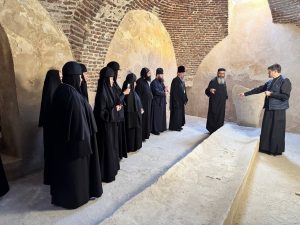
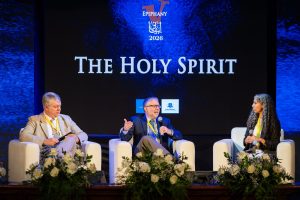
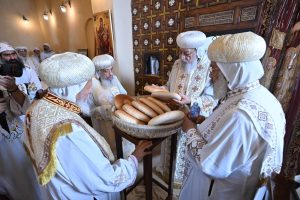
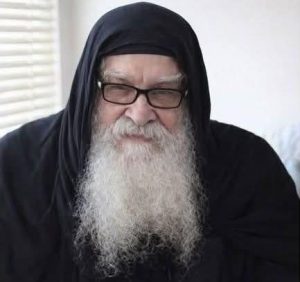
At its premises in Heliopolis, the School of Alexandria organised the first study gathering dedicated to the anniversary of the repose of His Grace Anba Epiphanius, Bishop and Abbot of the Monastery of St Macarius, under the name “Epiphany”, on 29 July 2022. The study day was attended by nine speakers and about seventy listeners, most of them disciples and friends of Anba Epiphanius who had come especially to honour his memory. The Monastery of St Macarius also took part by sending two monks, who attended the sessions of the gathering.
The meeting began at 11 a.m. and ended at 5 p.m., with a short break in the middle of the day.
The monk Fr Seraphim el-Baramousy opened the proceedings with a word fragrant with his great love for Anba Epiphanius. He explained that those responsible for the School of Alexandria had asked themselves how they could best honour the memory of Anba Epiphanius, and imagined putting this question to Anba Epiphanius himself. The answer came as an inspiration: the best way would be to organise a study day bringing together his sons and disciples. From this arose the idea of a forum on the subjects in which Anba Epiphanius had been interested and on which he had worked in his studies and publications during his life. Although less than a month passed between the first spark of the idea and the day of the anniversary, the Lord clearly smoothed the way. As soon as people began to speak of Anba Epiphanius, those present felt that he was among them in spirit, sitting on the last bench as he used to do at conferences, as if he were an ordinary listener.
Because of the importance of Fr Seraphim’s opening address, we publish it in full at the end of this account of the gathering.
The first paper was presented by a monk of the Monastery of St Macarius on “The Paradise of the Monks” (Bustan al-Ruhban), one of the Christian Arabic texts that Anba Epiphanius cared about greatly and of which he published a critical edition. After presenting the bishop’s role in bringing out the scholarly value of the Bustan, the paper stressed that the Bustan presents its literary material with unparalleled creativity, and that although the Copto-Arabic Bustan goes back to sources in other languages, it remains largely independent in its handling of them. Saying 388, attributed to Abba Macarius, was presented as evidence for this thesis.
His Grace Bishop Anba Makary presented the second paper, which many felt was a wonderful, unplanned complement to the first. His paper dealt with hagiographical literature; His Grace stressed how the texts of the lives of the saints developed over the centuries, across languages, and according to the historical and ecclesiastical circumstances in which they were written. Anba Makary’s paper also agreed on the great independence shown by translators into Arabic in transmitting the lives of the saints.
Eng. Rafik Adel then spoke about the complex manuscript tradition of the “Apostolic Tradition” attributed to St Hippolytus, an ancient Christian work setting out a body of principles, rules and instructions concerning church order, liturgical practice and church life, which express the way in which the early Church translated the concept of the apostolic tradition for the good and spiritual edification of all the faithful. Historians consider this book extremely important as a valuable source of information on the life of the Christian community and its liturgy in the third century.
Daniel El-Qommos Youakim then presented a comparison between the Coptic and Jerusalem traditions regarding the readings of the first three days of Holy Week (Pascha), referring also to the Armenian and Georgian traditions because of their importance.
Dr Bassem Samir El-Sharkawy dealt with the question of Origen’s Hexapla by placing it in dialogue with the Psalms manuscripts found at Qumran, which differ from both the Masoretic text and the Septuagint.
Mina Ayad Yassa spoke about the famous homily entitled “The Virgin Theotokos”, delivered by St Proclus of Constantinople between 428 and 429 (before he became patriarch). Proclus is considered the first to give the Virgin the title “Theotokos” in this way, which provoked a violent reaction from Nestorius, who opposed the title. The homily was later included in the acts of the Council of Ephesus in 431. The researcher compared parts of the homily with the fifth part of the Wednesday Theotokia, which begins “A virginal feast”.
Hegumen Fr Youhanna Atta dealt with the work of John Philoponus (490–570), philosopher, scientist and grammarian, who led the philosophical school of Alexandria after the death of Ammonius, son of Hermias (523). Philoponus is considered the first Christian commentator on Aristotle. Although he criticised some Aristotelian ideas incompatible with Christian thought, such as the eternity of the world, he sought to reconcile the Platonic–Aristotelian tradition with the Holy Scriptures. The paper focused on how Philoponus used logical reasoning according to the Aristotelian categories to demonstrate the one nature of Christ.
Dr Boutros Karam sent his paper, the last to be presented, as he was unable to attend in person. It dealt with the origin of the rite of the holy kiss and its development over the centuries in the various Churches, highlighting the historical moments when this rite disappeared from the liturgy and when it returned. The author also called on the Church to give this rite its proper place, because of its very great biblical, theological, spiritual and liturgical importance.
The organisers of the study day promised to repeat this fine initiative every year, and will soon begin organising the second gathering for the fifth anniversary of the repose of Anba Epiphanius (2023) with a call for papers, to be assessed by a dedicated committee. Those responsible also announced on the website of the School of Alexandria that the video recordings of the papers will be published, as well as a volume of the proceedings, at a later date.
***
 Address of Fr Seraphim el-Baramousy at the opening of the gathering
Celebrating the Light!
Epiphanius is a word that points to revelation… manifestation… unveiling… disclosure. And the greatest disclosure was the revelation of the Son of God in the flesh, and thus of the Trinity, in the face of Jesus. We can, in all sincerity and awareness, extend the meaning of the epiphany to include the celebration of every revelation of the life of Jesus in the life of a human being.
From this perspective we can lift the veil on one of the meanings of holiness: it is a great epiphany, a celebration of the divine light in the life of those who have followed the Lord Jesus. It is the fulfilment of the project of restoration in Him and for Him, that we may be after His eternal, victorious and risen likeness.
Anba Epiphanius was a monk in whom grace celebrated, and today, in his memory, we celebrate the revelation of the life of Jesus in him and through him.
The title of monk was the one closest to his heart, the one dearest to his soul. His monasticism was not rigid but active and dynamic, listening to grace and submitting to it, moving to the rhythm of its trumpet whenever it entrusted him with a task. He did not only love the liturgy of the Church: his very life was a great liturgy in which he believed everyone has a part.
Grace entrusted him with the gift of research, study and constructive reading. The gift seemed innate and spontaneous; he breathed it, and sought to help those around him to enjoy what he himself enjoyed.
His commitment to research was part of a wider project of salvation, in which every arm is strengthened to build, with all zeal, sincerity, sacrifice, awareness and discernment, the Lord’s building in hearts.
The great reward that gladdened him, as those who knew him closely realise, was to see the light spread, reign and extend into the persons, institutions, currents, ideas and lives around him.
His whole life was a ceaseless service of the Church as Christ willed it and loved it: one bride, conscious, firm and united, with a voice in the world; a Church not torn apart by marginal things, that does not withdraw out of fear of the great confrontations, does not retreat before threats, and does not swerve even if the kingdoms of the earth and their power are offered to her!
He did not build his project on a human ambition that the picks of despair could strike down and shatter. His project was rooted in the soil of hope… “and hope does not put us to shame, because God’s love has been poured into our hearts through the Holy Spirit who has been given to us.”
He believed completely in the accumulation of work, but he feared the fragmentation of the goal into smaller goals! Which is what so often happens.
Anba Epiphanius knew how to listen at a time dominated by noisy chatter that has filled ears with straw and gravel!
His feelings were aflame at a time when dullness had struck many, and dreams had died in hearts before they could see the light!
Sometimes he wept like a little child, with a trembling voice. His episcopate, with its cares and responsibilities, did not make him lose his fresh passion and the pure love that leapt up in the presence of his Beloved and Saviour, and of those who love his Beloved and Saviour.
He would be filled with awe, as if shrinking, in the presence of Christ manifest on the altar in His Eucharistic presence. It seemed that in those moments his heart beat with pulses that held on to the horns of the altar, imploring the Lord to come, dwell and make His home in him.
When he was praised, he would refer the praise to others, to the fathers of the Monastery of St Macarius under whom he had been a disciple. He saw himself as a boy among giants, he who became a giant in the Spirit in the eyes of all who saw in him the face of Jesus.
He was tender of heart, overflowing with a kindness that shone in his eyes with captivating goodness, and in his voice with a warmth that seemed to embrace those around him.
But he was a human being… he complained… he suffered… he questioned… he was in pain… he was even perplexed.
Yet in his perplexity he was without despair, and in his sorrow he was filled with joy unspeakable and full of glory.
This is a day on which we gather to remember a presence that cannot be absent or made absent, because it has been united with the Eternal, who is present unto the ages of ages. Amen.
Thank you.
Seraphim el-Baramousy
The first “Epiphany” study gathering
2022